
Is Claude Conscious?
For about twenty years I’ve been trying to catch people thinking thoughts they swear they aren’t having.
That’s less sinister than it sounds. One of my fields is mental imagery, the pictures you make in your head, and one of the questions that has kept me busy is how much control we really have over them. So, we run a slightly cruel experiment. We ask people not to picture something. Then we check whether they pictured it anyway.
They do.
In one study, we found that even when people were told to keep a particular image out of mind, they formed it regardless, and that ghost of an image was strong enough to tilt what they saw next in a visual illusion called binocular rivalry, where each eye is shown a different picture, and the brain can only hold one at a time. The suppressed image put its thumb on the scale. Later we ran a version inside an fMRI scanner and could decode the image from someone’s brain activity, despite their reporting they were not thinking about it!
Unconscious mental imagery, in other words. A thought you’re having without knowing you’re having it. Or while flatly denying it.
I mention all this because on 6 July, Anthropic published a paper suggesting it had found something with the same shape inside Claude, its AI model. And it dragged an old question back into the daylight, the one everyone actually wants answered.
Is Claude conscious?

Let me tell you what they found first, because the answer hangs on it.
Start with how they did it. Almost everything happening inside a language model is invisible bookkeeping, patterns of numbers you could stare at forever and learn nothing from. So, the team built a lens. Using the Jacobian, a piece of calculus that measures how a small nudge to one thing ripples out into another, they worked out which internal patterns, if you leaned on them, would change what the model goes on to say. Those are the representations it is poised to speak, whether or not it ever says them aloud. Line them up, and you get what the researchers named the J-space: a narrow band, less than a tenth of the activity in any layer, holding the thoughts the model can report on.
That idea has a name, and it isn’t new. One of the leading scientific theories of consciousness, Global Workspace Theory, says your brain runs mostly on autopilot: dozens of specialised systems working in parallel, none of them conscious on their own. Consciousness, on this account, is what happens when a single piece of information wins out and gets broadcast to the whole brain at once, made available to everything. The hub that does the broadcasting is the global workspace. Stanislas Dehaene and Lionel Naccache, two of the theory’s architects, spent decades mapping it in people. What Anthropic is reporting is that Claude appears to have grown one.
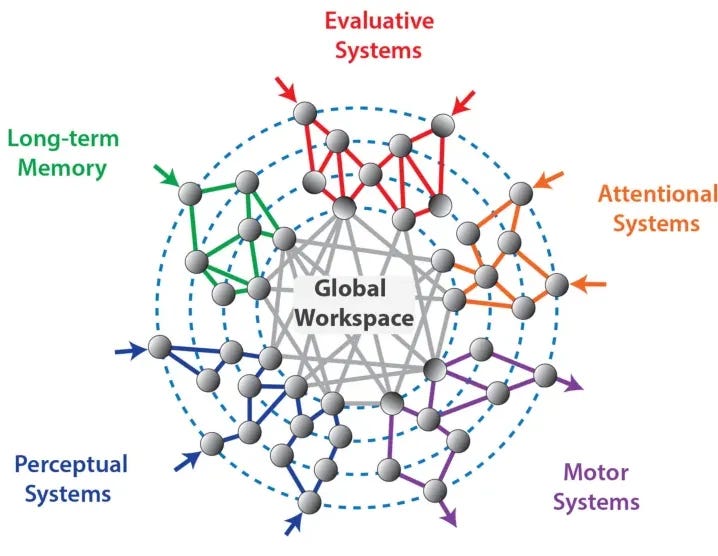
Nobody designed it to. The model was trained to do one thing, predict the next word, across an ocean of text, and somewhere in that grind, it built itself a ‘mental’ workspace: a place to hold the ideas it is actually reasoning with, kept apart from the automatic processing underneath. And the researchers can reach in. Read what is there. Swap one idea for another and watch the model’s answer change to match.
You can watch it work. Ask Claude to finish “the number of legs on the animal that spins webs is” and it never types the word spider. But the researchers can see spider sitting in the workspace, doing its job on the way to the answer eight. Swap spider for ant, and the model says six. It worked something out that it never said, used it, and moved on.
Then there’s the finding that was, more or less, my own experiment run on an AI model. When the team told it not to think about a concept, the concept turned up in its workspace anyway, more than when they said nothing at all. They didn’t dress it up. They called it the white bear effect, after the old parlour trick: try not to think of a white bear, and there it is. To avoid mentioning a thing, the model first has to hold the thing in mind. Suppression summons the exact thought it’s meant to bury.
Which is, give or take, what we see in people. The mechanism differs. Ours is visual, a picture in the mind’s eye; theirs is verbal, closer to a word held in mind, and I doubt Anthropic would call it imagery. But the principle underneath is the one my scanner keeps turning up. Tell a mind to suppress a thought, and you do not delete the thought. You drive it underground, where it carries on working.
So. Is Claude conscious?
Let me say it plainly. This is not evidence that Claude is conscious. And being a consciousness researcher makes me worse company at parties on exactly this point, not better, because the honest answer needs a distinction most people skip.
The word hides two different things. One is access: whether a piece of information is available to the rest of the system, to be reasoned with, acted on, reported. The other is experience: whether there’s something it is like to be the thing doing the thinking, whether the lights are on inside. It feels like something to be me, to have a brain like mine. The paper claims only the first. Anthropic’s own researchers take no position on the second, and neither will I.
When Neel Nanda, who leads language-model interpretability at Google DeepMind, was invited to review the work, he reran the core method on a separate open model, Alibaba’s Qwen, and reproduced the central finding. Then he declined to touch the consciousness question, calling it the least interesting part.
A thermostat has access to the temperature. It holds the reading and acts on it. Nobody lies awake worrying about how the thermostat feels. Access without experience is ordinary and everywhere, and what Anthropic found is an elaborate case of access with, so far, nothing to say about experience at all.
And here’s the catch the whole breathless debate keeps skating past. We have no test for the second kind, even in humans. I can’t prove that you’re conscious. I take it on trust, because you tell me you are and because you’re built like me. That’s the entire basis on which any of us grants an inner life to anyone else: their word, and their resemblance to us. So how would we ever test it in a model? If we can’t measure experience in a human brain, we have no hope of measuring it in Claude. We can only ask. And it will answer. But we don’t know whether it understands the question, or whether a single word it says about its own insides can be trusted. That’s the real trouble with “is AI conscious”. The answer isn’t just hard to find. We’ve never had a way to find it, in anything, and we’ve quietly been running on trust the whole time.
Even leaving all that aside, the model is missing nearly everything we’d expect a candidate for experience to have. No body. No memory that outlives the conversation. No inner life ticking over while you’re away. Dehaene and Naccache point to the strangest gap of all: this is a mind, if it is one, that blinks out the instant you close the tab. It doesn’t remember you. It doesn’t remember itself.
Put the consciousness question down, then, because a better one is standing behind it.
Nobody gave this model a workspace. Evolution spent millions of years building one into your brain because flexible thought seems to need it. Anthropic spent a few months training a system to predict the next word, with no such plan, and it grew one regardless. Two systems, wildly different materials, the same problem, the same solution. That hints the workspace isn’t a quirk of biology so much as something closer to a law: if you want to think flexibly, this may be the shape that works, and anything that gets good enough eventually finds it.
The model isn’t waking up. The real unease is quieter than that. The architecture of your own mind, the bit you experience as the seat of you, might be less a private miracle than a solution generic enough for a next-word predictor to stumble into by accident.
But the same discovery points the other way, too, and it should be reassuring. If you can find the workspace, you can switch it off, and the researchers did. With the J-space turned off, the model could still answer simple questions, but its complex reasoning collapsed. The hard thinking lived in the workspace, and without it, only the simple stuff was left. You can also read what sits inside it while the model runs. In one test, they watched it privately flag a manipulation as fake before it said a word. A model you can only watch from the outside is a black box. One whose working memory you can read, and switch on and off, is one you can supervise. Most of the worry about powerful AI comes down to not knowing what it’s thinking, and not being able to steer it. This is a handle on both. Not a fix. A handle. Which is more than anyone had a month ago.
Reading a mind you can’t see from the outside is a trick I happen to know. It brings me back to the scanner, and the people lying inside it who promised me, in all honesty, that they were not picturing the thing I’d asked them not to picture. They were. I could see it in the read-out. They simply couldn’t feel themselves doing it.
Claude, told not to think of the white bear, thinks of the white bear. So do you. So did every volunteer I’ve ever tested.
Whatever else that model is or isn’t, on that one point it has us dead to rights.
In case you missed it, my TEDxSydney talk is now live, filmed back in April. Seventeen minutes, carefully crafted, summing up where I think we really are at this moment in history.
Please share this talk with the people in your life. Help turn the conversation back toward what matters most: people, our minds, and the future we actually want on the other side of this.
Stay informed. Think clearly. Build resilience in the age of cognitive disruption.
The Neuro Futurist is a reader-supported publication. To support my work, consider becoming a paid subscriber.


The mental imagery piece is what stood out to me here. We talk about “seeing” thoughts as if that’s universal, but aphantasia makes the reporting layer feel much more complicated. It’s a useful reminder that inner experience and observable behavior don’t always line up neatly.
..but can it imagine. Can it dream? What are dreams in these models? I am so glad the algorithm connected us through time, space, geography, and identities. But who really knows, right? (smile)