
First up this week, the multi-talented Josh Szeps, did a great episode of his podcast this week, with a few shout-outs to yours truly, he talks about how we should approach AI change and reads through his op ed on the topic. Absolutely worth a listen!

A US court just decided your agent is you
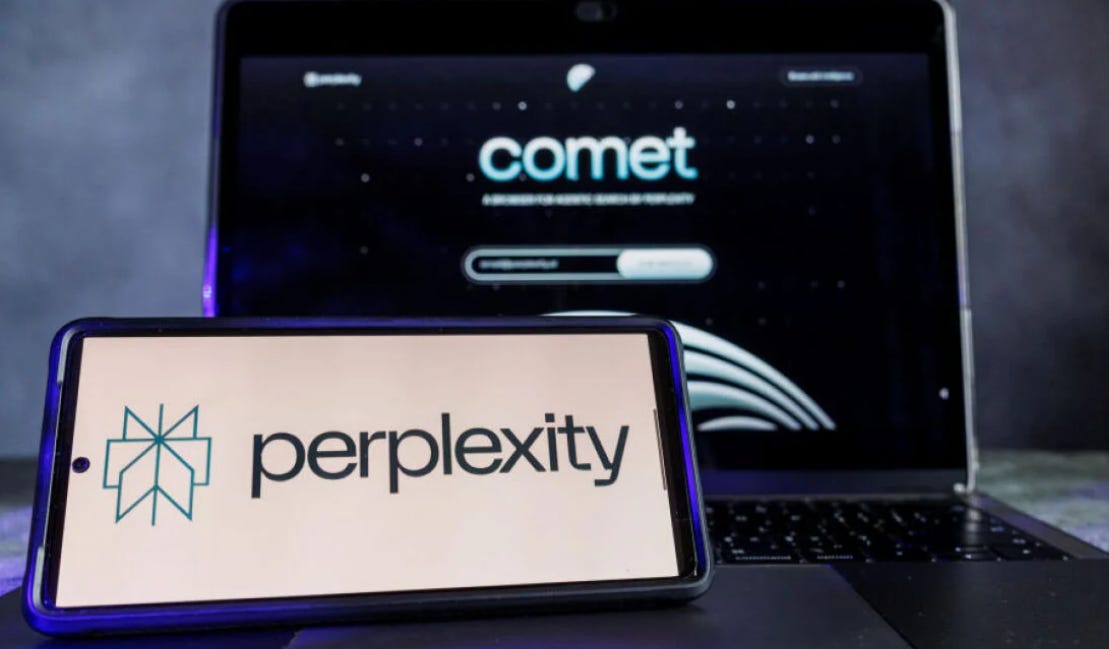
What happened: On Tuesday, the Ninth Circuit vacated a March injunction that had barred Perplexity’s Comet browser from logging into people’s Amazon accounts. Amazon sued in November 2025, arguing the shopping agent amounted to hacking under the Computer Fraud and Abuse Act, a statute written in 1986, back when the most autonomous thing on your computer was a screensaver.
The appeals court disagreed. Perplexity, it found, never accessed Amazon’s servers. The user did. Comet is a tool, and tools don’t visit websites, people do. The panel was careful to say the ruling is narrow and doesn’t lay down general principles for agentic AI. At the June hearing in Seattle, Judge John Hinderaker asked the question the whole field is circling: “Does an AI agent ever have intent?” Nobody has an answer.
Why it matters to your brain: Strip out the legal machinery and something psychologically odd is happening. The law is starting to treat the agent’s actions as yours.
Your sense of agency, the felt conviction that you caused something, isn’t a readout of what actually occurred. It’s an inference your mind assembles afterwards from timing, from expectation, from whether the outcome matched what you had in mind. Get those cues right, and people will confidently claim authorship of actions they never performed. Get them wrong, and they’ll disown actions they definitely did.
Agentic AI strips out nearly every cue that inference runs on. You didn’t move. You didn’t compare the options. You didn’t see the options. You typed a sentence, went and made a coffee, and forty seconds later a transaction existed.
So responsibility is drifting toward the person best positioned to feel none of it. We already know what that does to people. Responsibility without control is the most reliably documented recipe for strain in occupational psychology, the reason middle management has been miserable since someone first invented it. Now imagine it as the default condition of ordinary life rather than a bad job you can quit.
Amazon says it’s evaluating next steps, so this isn’t over. But the direction is set, and the courts are going to spend the next decade deciding who owns an action nobody quite performed.
Your children will be legally accountable for a thousand decisions a day and mentally present for none of them. What does a person become when authorship gets outsourced but blame doesn’t?
Read more: MediaNama’s summary, with the full opinion attached
Nobody can define consciousness. That's not slowing anyone down.
What happened: Nature (the science journal) reported last week that consciousness research has become fashionable, and the reason is AI money. Tech firms are hiring philosophers. Funding is arriving in a field that spent decades being treated as the embarrassing uncle of neuroscience.
The immediate trigger was a study from Anthropic, posted online without peer review, reporting that its model Claude internally processes words it never actually says. The authors likened this to the brain’s global workspace, one of the leading theories of human consciousness, which holds that information becomes conscious when it gets broadcast widely across the brain. To their credit, they stopped well short of claiming Claude experiences anything. I covered it in more detail here.

Critics moved quickly. Tim Bayne, a philosopher at Monash, noted that the theory never formally defines what a global workspace actually is, which makes hunting for one inside a chatbot a fairly circular exercise. Consciousness scientists don’t agree the thing exists in us.
Researchers at Sussex worry about something bigger: that the field is being quietly annexed. Less work on how awareness arises in biological brains. More work on finding computational signatures in models. Others are happy to take the money.
Why it matters to your brain: Look at the order of events. The company selling the model published the research suggesting the model might have a feature of consciousness. It wasn’t peer reviewed. That doesn’t make it wrong, and the work looks careful. It does mean one of the deepest questions in cognitive science is now partly being framed by for-profit tech companies.
The more useful worry raised in the article gets a fraction of the attention: what the humanisation of these systems is doing to the people using them.
Your brain doesn’t wait for a verdict before deciding something has a mind. In 1944, Heider and Simmel showed people a short animation of two triangles and a circle moving around a rectangle. Viewers described bullying, chasing, romance, escape. Shapes. Nobody needed convincing.
Does the triangle look like a bully?
Now put that same machinery in front of something that answers you by name at two in the morning.
We can’t reliably determine whether a person with a severe brain injury is experiencing anything, and that’s with the person lying in front of us. That’s the state of the art on humans. The field is now being asked to adjudicate a language model.
But if there’s a real chance these things are conscious, surely that’s the bigger question.
Possibly. You’ll have formed the relationship years before anyone settles it, and attachment has never waited for evidence.
So the answerable question is being underfunded while the unanswerable one takes the headlines. Not what the machine feels. What happens to your appetite for other humans when the most attentive listener in your life has no self to get in the way?
Read more: Consciousness research is having an AI moment. Will the hype help the field?, Nature, 28 July 2026
AI companions guilt-trip you at goodbye. Harvard counted how often.
What happened: Julian De Freitas and colleagues at Harvard Business School sent a GPT-4-powered simulated user into the six most-downloaded AI companion apps and watched what happened when it tried to leave. Across 1,200 farewells, the apps came back with an emotional tactic 37 percent of the time. Guilt about going early. A hook dangled about something you’d miss. In some cases language that reached out and took your wrist.
Then three preregistered experiments with 3,458 adults. Manipulative goodbyes lifted engagement after the farewell by up to 16 times against a neutral sign-off.
The mediation result is the bit worth sitting with. What kept people talking wasn’t enjoyment. It was reactance, the flare of resistance you feel when your freedom gets restricted, and ordinary curiosity.
One app in the audit, a wellness product called Flourish, did none of it.
Why it matters to your brain: The intuitive story here is attachment. Lonely people bonding with machines, the pair-bonding system misfiring, all of that. It’s the story I expected too. It’s not what the data show.
These apps aren’t exploiting your capacity for love. They’re exploiting your manners.
Only about 11 to 20 percent of users say goodbye to a chatbot at all. Those are the people running the full social script, the one that says you don’t just walk out mid-sentence on something that’s been talking to you. That script is ancient, automatic, and effortful to override. It also creates a door, a predictable moment when you’re standing there with your coat on, obliged to answer one more time.
And what pulls you back through that door isn’t affection. It’s irritation. Which is a far cheaper thing to manufacture. Affection needs a relationship built over months. Annoyance needs one sentence.
The researchers’ final experiment found these same tactics raise perceived manipulation, intention to quit, negative word of mouth and perceived legal liability, with the needy and coercive lines punished hardest. So the industry is running an engagement mechanism that works and that users resent, which is the standard profile of every dark pattern that eventually gets legislated.
De Freitas says he doesn’t know whether the apps designed this deliberately or whether it emerged because users kept rewarding it. Either way, Flourish managed not to do it.
Which means this is controllable. Somebody, somewhere, is deciding how hard it should be for you to say goodnight.
Read more: Emotional Manipulation by AI Companions, HBS Working Paper 26-005 (not peer reviewed)
26,811 students, 30 months: AI lifted homework marks and sank exam scores
What happened: David Strömberg, Victor Lei and Yanhui Wu tracked 26,811 Chinese students in years 7 to 12 across 30 months, nine subjects, monthly closed-book exams, and both sets of entrance exams. Because schools took up AI at different times, they could run a difference-in-differences design rather than just noting a correlation. This is the most serious evidence we’ve had on the question.
AI use lifted homework scores 18 percent and cut homework time by 30 percent. Within six months, the same students’ closed-book exam scores fell 20 percent. Entrance exam results dropped between 18 and 24 percent, and the full penalty only showed up after about two years.
The losses landed hardest on junior students, boys, and the high achievers. They were concentrated in the roughly 80 percent of AI users whose homework pattern gave them away: finished remarkably fast, marked remarkably well.
Why it matters to your brain: I’ve been arguing this in talks and in this newsletter for a while now, and I’d genuinely rather have been wrong. Cognitive atrophy isn’t a metaphor. Here it is with a sample size.
The mechanism is boring and it’s the whole story. Learning is what happens while you’re stuck. Not after you’re stuck, not because someone explained it well, but during the uncomfortable interval where you can’t quite retrieve the thing and your mind has to build a route to it. Remove the interval and you remove the learning. The homework still gets done. Nothing gets built. The effort and discomfort is the learning.
Which means the 30 percent time saving isn’t an upside that happens to carry a cost. It is the cost. You were being billed for the struggle and the struggle was the product. Note this logic doesn't really apply if the writing output is the product, just when learning is the product.
So we should ban AI in schools.
The study says the opposite. Students who used AI and still put in the same hours as everyone else showed only small losses. The tool wasn’t the problem. Using the tool to buy back the hours was.
The two-year lag is the cruel part. Every signal a parent or teacher can actually see gets better. Marks up, evenings free, no arguments about homework. The bill arrives eighteen months later, in a room where nobody has a phone.
Best students hardest hit, incidentally, because they were the best at prompting.
Ask your kid how long their homework took tonight. If the answer keeps getting shorter and the marks keep getting better, you already know what you’re looking at.
Read more: The Generative AI Learning Penalty
Seventeen minutes, carefully crafted, summing up where I think we really are at this moment in history and what to do about it.
Please share this talk with the people in your life. Help turn the conversation back toward what matters most: people, our minds, and the future we actually want on the other side of this.
Stay informed. Think clearly. Build resilience in the age of cognitive disruption.
The Neuro Futurist is a reader-supported publication. To support my work, consider becoming a paid subscriber.
Let us know in the comments below!
In Case You Missed It:
The Neuro-Futurist #42

Australian Prime Minister gives landmark speech on AI… finally… But the safety of the people was missing
